


ABOUT Simple Syntax
THE ZEN OF PYTHON
by Tim Peters
Beautiful is better than ugly.
Explicit is better than implicit.
Simple is better than complex.
Complex is better than complicated.
Flat is better than nested.
Sparse is better than dense.
Readability counts.
Special cases aren't special enough to break the rules.
Although practicality beats purity.
Errors should never pass silently.
Unless explicitly silenced.
In the face of ambiguity, refuse the temptation to guess.
There should be one-- and preferably only one --obvious way to do it.
Although that way may not be obvious at first unless you're Dutch.
Now is better than never.
Although never is often better than *right* now.
If the implementation is hard to explain, it's a bad idea.
If the implementation is easy to explain, it may be a good idea.
Namespaces are one honking great idea -- let's do more of those!
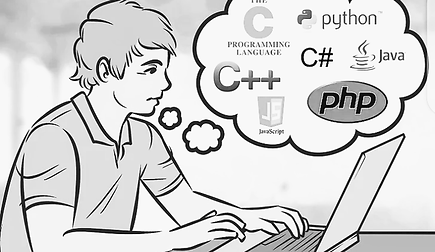
Learning to code can be very confusing at first. While all programmers, including myself, are still learning, some things can be made a little easier to understand to get people started. It can be intimidating when first hearing things like data type, strings, integer, boolean, variables, functions or classes. For people that do not understand the jargon, it can make it even more difficult. I have found that explaining code to myself in words that are easier to understand, it can make things a lot more straightforward. For example, a variable can simply be thought of as a box to hold information in, then use it when you need it.
This blog will attempt to show and explain some examples of coding fundamentals and make it so that it is explained in a much more simple and digestible way for everyday people.
I hope it is helpful for anyone viewing it.
ABOUT ME
I am still fairly new to coding and programming myself. I found early on that people who are good programmers, are often quite bad at teaching it. They tend to jump ahead far too quickly with the words "See? It's simple", when in actual fact, to everyday people it is not simple.
QUICK TIPS
When you learn about a concept in programming, practice it. For example, if you learn about variables, try write different pieces of code to use them in different ways. Don't just watch a video on it then think you know it. It tends not to stick, then when you get further ahead, you get confused. Practice every concept.
Check syntax. If your code does not work, try look where there may be errors. A print statement could be using a capital P instead of a lowercase p. An integer variable might have been assigned a decimal value. You may have assigned a letter to an integer. You could be missing a bracket. If it becomes difficult, Google the syntax, such as "Python print statement syntax". All languages have rules, including programming. Checking the syntax will help alot.
Don't think you are being or cannot "just get it". Python is an easier language, but this is again a problem with good programmers. It is easy for them. For new people, it can still be quite difficult. Be patient, take your time.
Coding and programming are not the same. Try to think of coding as the code and technical skill while think of programming as a way of thinking and problem solving. Code is the implementation of a program.
STARTING OUT
Before you begin, please be sure to navigate to the home page and download the required resources. These will be the Sublime Text editor and Python. Links to both can be found on the home page.
The first blog post "A simple programming environment" found here will help to guide you in setting it up
Follow Simple Syntax
If you havn't already, please follow Simple Syntax at the links below to be notified of updates

